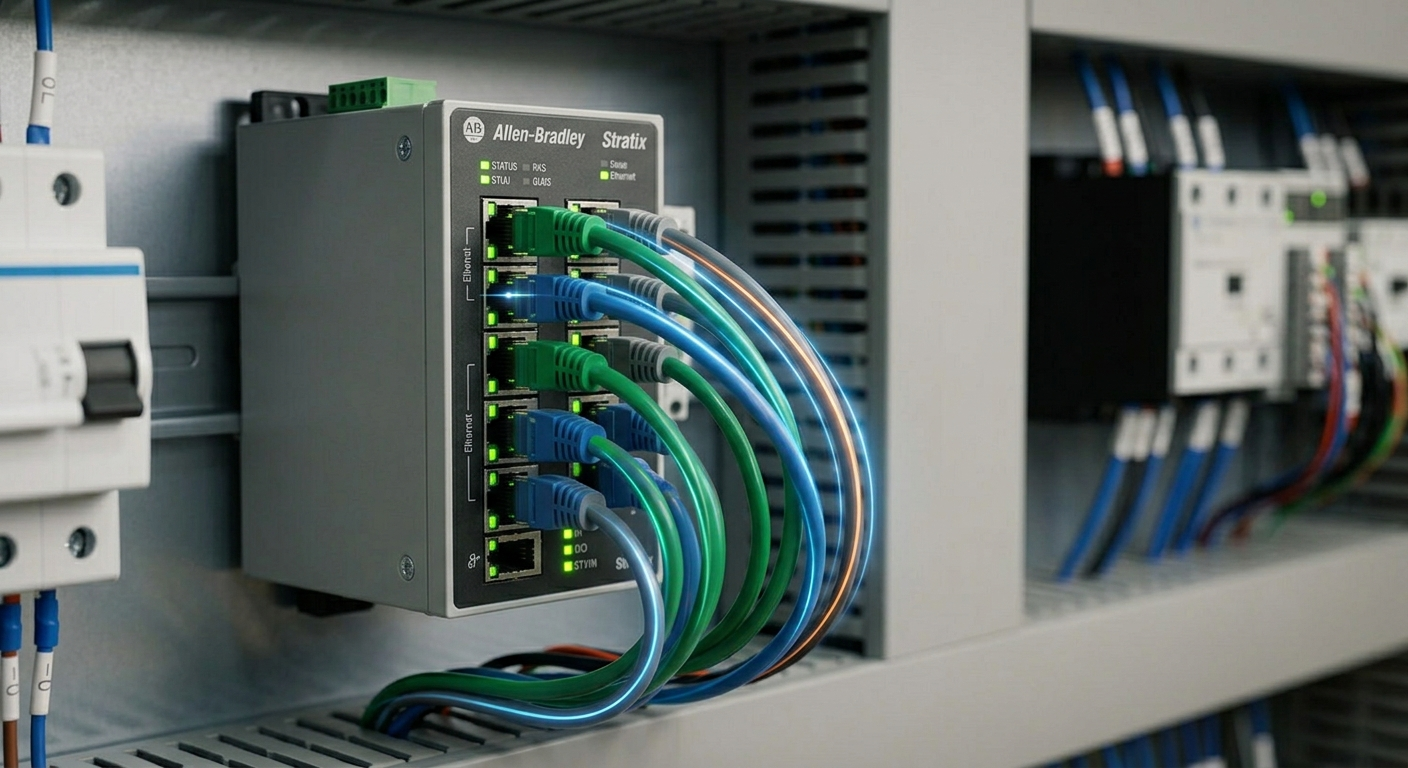
Industrial Ethernet is the use of Ethernet-based networking in control systems where device timing, availability, diagnostics, and environmental conditions matter. It connects PLCs, HMIs, drives, remote I/O, robots, safety devices, and supervisory systems.
More than an office network
The cables and protocols may use familiar Ethernet foundations, but control networks must account for machine cycle timing, managed infrastructure, electromagnetic noise, topology, and planned maintenance. A network that is fast in a file-transfer test can still be poorly designed for cyclic I/O.
Common devices
- Controllers and engineering workstations
- Remote I/O adapters and drives
- HMIs and operator terminals
- Robots, vision systems, and safety devices
- Switches, gateways, and plant data systems
Design considerations
Document IP addresses, subnets, switch ports, device names, VLAN boundaries, and approved access paths. Use suitable industrial components, secure cabinets, strain relief, and a topology that can be diagnosed. Avoid undocumented daisy chains and unmanaged exceptions.
When communication fails
Check power and link indicators, device identity, addressing, switch status, cable condition, and project configuration in that order. A device may be reachable but still have a failed cyclic connection. See PLC network troubleshooting and What is EtherNet/IP?.
TechControl supports industrial controls and network troubleshooting for existing machines.
Ready to bring your project to life?
Contact Us