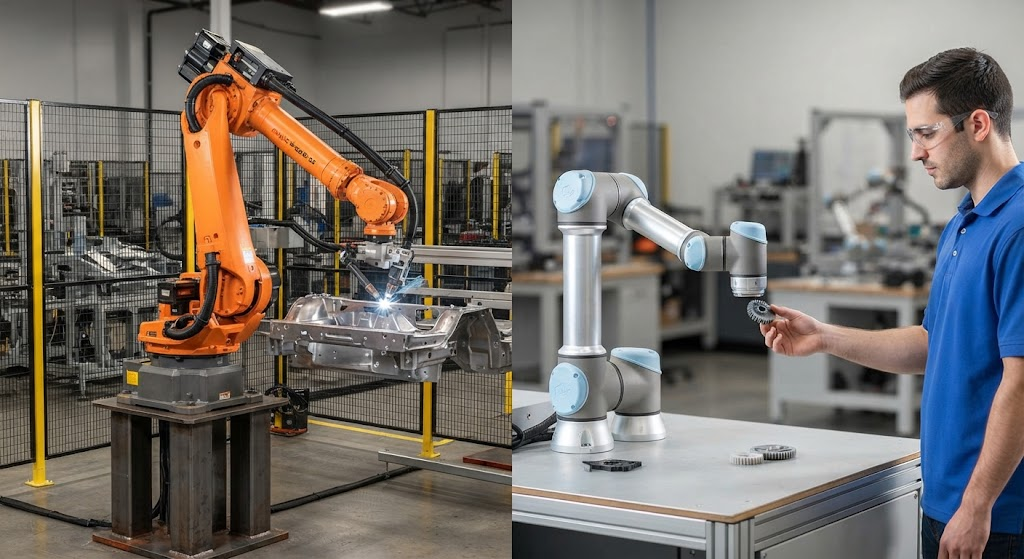
Industrial robots and collaborative robots can both automate material handling, assembly, inspection, and machine tending. The choice depends on speed, payload, reach, product, people, guarding, cycle time, flexibility, and the validated risk assessment.
Industrial robots
Traditional industrial robots are commonly selected for high-speed, repeatable production and heavier payloads. They often operate inside a guarded cell with safety-rated access control and a defined automatic cycle.
Cobots
Cobots can suit lower-payload, flexible applications where setup, changeover, or closer operator interaction is valuable. Their collaborative functions do not remove the need to assess tooling, product hazards, pinch points, and unexpected movement.
Comparison
| Factor | Industrial robot | Cobot |
|---|---|---|
| Typical priority | Speed and payload | Flexibility and interaction |
| Safeguarding | Often guarded cell | Application-specific assessment |
| Changeover | May require more integration | Can support flexible setups |
Choose from the complete cell
Evaluate end-of-arm tooling, conveyors, PLC handshakes, vision, safety, maintenance, recovery, and product quality along with the robot arm. TechControl provides robot cell design and integration.
Ready to bring your project to life?
Contact Us